
 Sign In
Fire Emblem: New Mystery of the Emblem - Heroes of Light and Shadow (Nintendo DS) Review
By Rudy Lavaux  12.01.2013

Those of our readers that have been following the Fire Emblem franchise since it saw a first release outside of Japan on Game Boy Advance, and eagerly awaited every single new title since then, cannot have missed the fact that one important recent game has yet to see the light of day overseas. Fire Emblem: Shin Monshou No Nazo ~Hikari to Kage no Eiyuu~ (or Fire Emblem: New Mystery of the Emblem ~Heroes of Light and Shadow~ as it should be named for us) came out in Japan in July 2010. Shadow Dragon, the previous installment on Nintendo DS, was a remake of the very first episode for the Famicom. The same game was already remade for the Super Famicom in 1993 in Fire Emblem: Monshou no Nazo (Mystery of the Emblem), which contained two "books;" the first one being a slightly more condensed version of the Famicom original, ditching a handful of maps and recruitable characters, and the second one a completely new story that takes place several years after the events of the first chapter and expands on the story of the original. Although this is kind of complicated to put into words, it's fairly simple to understand: New Mystery of the Emblem is an enhanced remake of that second chapter. Read on for the specifics.
First and foremost, Cubed3 strongly advises its beloved readers who might not know what kind of game Fire Emblem is to read our review of the previous episode, Fire Emblem: Shadow Dragon, for an explanation on the basics of the gameplay found in this rather unique type of role-playing games.
As mentioned above, the action in this game takes place after the events of Shadow Dragon. A most evil shadow looms on the continent of Akaneia once again. The new king of Akaneia (or Archanea in Shadow Dragon's North American localisation), Hardin, who once fought alongside Marth in the previous war, is mistreating its people by sending its armies to bully the poor peasants. Meanwhile, Altea, one of the many vassal countries of Akaneia ruled by none other than Marth, famed Super Smash Bros. character and the hero of the previous game, is enjoying peace, but will soon be called to aid by Akaneia to fight against rebels from another vassal nation who are turning against their suzerain. It doesn't take long for Marth to notice that King Hardin's mind has changed quite a big deal since the last war, and finds out that he is not quite himself, being controlled by some obscure force. It's up to the army of Altea, lead by Marth, to travel around the continent once again, freeing people as they go and gathering more companions along the way to add to their ranks.
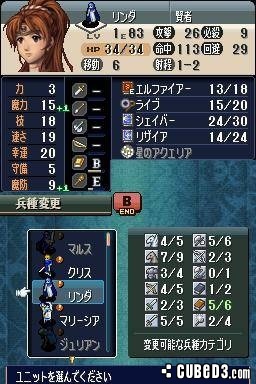
Most unique to this episode of Fire Emblem is the completely new feature called "My Unit." As soon as the game starts, the player is asked to create a character, choosing its social status and background, some basic character and physical traits... and gender. The latter then determines what classes he or she has access to, which players need to choose. While the name and other info cannot be changed afterwards and seem to have little impact on the story whatsoever, the class can be changed at any moment.
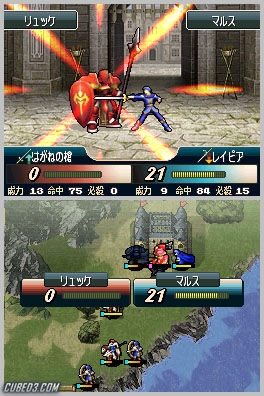
The reclass option from Shadow Dragon is indeed still present, however, it is not possible to reclass any character into a Ballistician and Shin Monshou no Nazo offers no recruitable allies that use this class, despite being a very interesting playable rank in the first game. The newly-created character is then introduced in the story and becomes an important part of it for the rest of the game.
The game opens on a new prologue which wasn't present in the original Super Famicom game, and sees "My Unit" enrolling into the army of Altea, getting to know some of the characters from the previous DS game, as well as completely new ones. These added chapters provide more back-story compared to the original, as well as a recap for those who don't know what happened in Shadow Dragon, and acts as a tutorial at the same time. More new chapters were added in the form of so called "Gaiden" chapters, which can only be accessed by meeting certain requirements and see the development of a new side-story happening between Marth, "My Unit," and another new important character introduced in the new prologue, all the while being tied to the main story in a sense, so as to not betray the original script too much, making for a nicely-wrapped little trick.
As if this was not enough content yet, four chapters called "Chronicles" are unlocked and become accessible in the "Extras" menu. These bring some more information on what happened to certain playable characters between Book 1 and Book 2 of the original Monshou no Nazo (or rather, in this case, between the two DS games). This comes as a nice surprise because they are none other than the four BS Fire Emblem games which were only released in Japan through the Broadcast Satellaview service for Super Famicom.
These games being originally only playable between set hours at which they were broadcasted through satellite communications, making them sort of complicated to emulate these days, let alone being played on their original system, makes them finally playable in a more definite way, which should make die-hard Fire Emblem completionists quite happy indeed. Not only that, but DSi owners also get to download additional content in the form of other chapters that play in much the same way as these "Chronicles." Unfortunately, we at Cubed3 cannot say much more about those, these being only accessible when the game is played on a Japanese DSi or 3DS due to the region-locked nature of DS games bearing DSi-enhanced functions.
Still in the area of online content, the basic functions of Shadow Dragon are all still present. Players are allowed to loan and rent units from other players, it is possible to battle against others online on multiplayer-specific maps, and, last but not least, the online shop is still present, offering some special items. However, these are apparently not any more exclusive to the online shop. Indeed, a new function is introduced this time around, called "How's Everyone." After a set amount of time has passed in the real world (the game checks the internal clock of the system), a gauge fills up and players can check what their characters have been doing whilst the game was not being played. They may have trained in players' absence, thus gaining a measly few experience points, they may also have become closer to another playable character, or they can find one of the aforementioned special weapons lying around. These include some very interesting weapons indeed, some of them bearing special effects not usually found in Fire Emblem games... or they can be totally useless, like a frying pan.
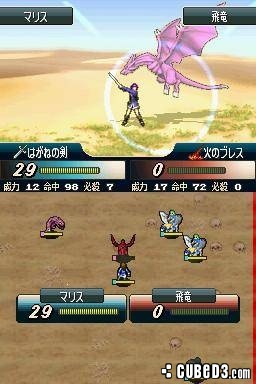
The latter won't take the appearance of a frying pan in battle, though, instead resembling an axe, the weapon class to which it belongs, which is most unfortunate as this would have made for some hilarious online battles.
Lastly, this game introduces a new gameplay choice, called "Casual" and "Classic." In "Casual," characters defeated during a chapter come back in the next one, making the adventure far easier to get into for newcomers, while "Classic" is meant for Fire Emblem purists who prefer the recipe to remain the same, which is that a dead character should remain dead for the whole game. That being said, the main characters still can't be defeated during a chapter, since that would lead to a "Game Over."
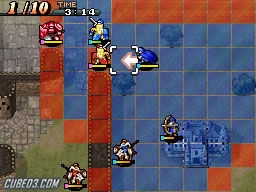
All around, New Mystery of the Emblem feels like a richer package than Shadow Dragon was. It still lacks some of the gameplay refinements found in the more recent episodes, such as being able to rescue unit A with unit B, like in the GBA episodes... however, it sports enough new ideas to be considered a completely new entry for those who never got the chance to try the original. The visuals are still mostly the same, except for character portraits which are better drawn this time, and match the visual style of the in-game artwork much better than in Shadow Dragon. Speaking of which, famed manga artist Masamune Shirow isn't responsible for the artworks in this game, but they are still very good. It's just sad that we must deal with the pre-rendered Playmobil style of character sprites inside battles this time, as well. Bottom line, except for the different story, it offers pretty much all of the same great action that Shadow Dragon offered, and even more, which means it's highly recommended to all Fire Emblem fans out there.
Cubed3 Rating

Exceptional - Gold Award

Despite Nintendo president Satoru Iwata stating back in 2010 that they were looking into bringing to the west games that were still only available in Japan, it seems Fire Emblem fans overseas were to be deceived, despite the series' popularity outside its home turf. In fact, we struggle to see what came out of these claims from the president of the Big N. Fire Emblem: Shin Monshou No Nazo ~Hikari to Kage no Eiyuu~ still bears some of the slight shortcomings of its predecessor in not integrating some of the gameplay staples the franchise introduced in more recent episodes and sticking to the ugly pre-rendered character sprites in battles. However, it does more things right than its aforementioned brethren; namely in the story department, character portraits and amount of playable characters, all while introducing the interesting new feature called "My Unit." All the more reason to call it a shame that the game will probably never see a release outside of Japan, especially when the new 3DS game, Fire Emblem Awakening, is slated for a release in Europe in April of this year. However, thanks to a recently completed project of translating this game to English, Fire Emblem: Shin Monshou No Nazo ~Hikari to Kage no Eiyuu~ can now be understood by English fans who can't read Japanese. Cubed3 reminds its dear readers than the use of such a patch on a ROM of the game requires that the player owns the actual game - thus in Japanese - for such a practice to be legal... but we shall leave that decision to everyone's own conscience. Bear in mind that Japanese DSi-enhanced cartridges such as this one cannot be played on a non-Japanese DSi or 3DS.
 Game Details
 Read Review
 Screens
 None
None  None
None  Out now
  None
None Comments
Comments are currently disabled
 Subscribe to this topic
 Features
 Review: Dementium: The Ward (Nintendo Switch)
 Review: Persona 3 Reload (PC)
 Review: Quantum: Recharged (Nintendo Switch)
 Tech Up! Skullcandy EcoBuds
 Review: Princess Peach Showtime! (Nintendo Switch)
 Review: Space Cats Tactics (PC)
 Review: Baldur’s Gate 3 (PC)
 Review: Football Manager 2024 (PC)
 Review: Diablo IV (PlayStation 5)
 Tech Up! Victrix Pro BFG Wireless Controller Review
 Review: Need for Speed Unbound (Xbox Series X/S)
 Review: Alone in the Dark (PC)
-
 Celebrate Pokémon Go’s 7th Birthday with Merchoid T-Shirts
 0
0  CRKD Launching Nitro Deck for Nintendo Switch 0
  Glasgow Anime and Gaming Con 2023! 0
  Picross returns with a new title and a sale! 0
  News: Super Mario Bros Movie Direct 9th March 2023 0
  News: Professor Layton and the New World of Steam announced! 0
-
Show More

 Upcoming: Comic Con Scotland NE
 News: Official PlayStation Internal SSD launches in partnership with Western Digital
 Tech News: Pioneer DJ Launches New DM Series Models
 News: Out Run-Inspired Arcade Racer Slipstream Out Apr 7th
 News: Mario Kart 8 Deluxe Booster Course Pass Out Now
 News: Pokémon Legends: Arceus Now Available


 Feeds
Feeds Facebook
 Twitter
 YouTube
 Top
Top

